The cost of returns in 2026: money, parcels and carbon
A return costs an online retailer in Germany €2.85 per item and €6.95 per parcel on average in transport and handling, before any loss on the goods. Processing US online apparel returns cost an estimated $25.1 billion in 2023, and each return parcel emits about 1,500 g CO2e where retailers measure it. Every figure on this page links to the study it comes from.
Director Sienna Stones was interviewed by Vogue College of Fashion (2 June 2026)
Key figures
Returns cost retailers three ways: handling each parcel, losing value on goods that cannot be sold as new, and the carbon of a second journey. Fashion carries most of it: 91% of returned items in Germany are fashion.
- €2.85average transport and processing cost per returned item, GermanyUniversity of Bamberg
- €6.95average transport and processing cost per return parcel, GermanyUniversity of Bamberg
- 27%of online retailers in Germany, Austria and Switzerland cannot put a figure on their cost per returnEHI Retail Institute, 2025
- $25.1bnestimated cost of processing US online apparel returns in 2023Coresight Research
- 560mreturn parcels forecast in German ecommerce in 2026, a recordUniversity of Bamberg
- 1,500 gCO2e per return parcel, mean among German retailers that measure itUniversity of Bamberg
Headline figures
| Metric | Figure | Source |
|---|---|---|
| Transport and processing cost per returned item (Germany) | €2.85 on average2021 data, published 7 September 2022 | University of Bamberg |
| Transport and processing cost per return parcel (Germany) | €6.95 on average2021 data, published 7 September 2022 | University of Bamberg |
| Online retailers putting processing cost at up to €10 per returned item (DACH) | 53.3%summer 2025 survey | EHI Retail Institute |
| Online retailers that cannot put a figure on their processing cost (DACH) | 27%summer 2025 survey | EHI Retail Institute |
| Cost of processing US online apparel returns | $25.1 billion2023 estimate | Coresight Research |
| Value of US retail returns, all categories | $849.9 billion2025 estimate | NRF and Happy Returns |
| Value of UK non-food returns | £26.7bn (2024), £25.1bn (2025 forecast)2024 to 2025 | Retail Economics and ZigZag |
| Return parcels in German ecommerce | 542 million (2025 estimate), 560 million (2026 forecast)2025 to 2026 | University of Bamberg |
| Returned items sold again as new (Germany) | 93.2%2021 data, published 7 September 2022 | University of Bamberg |
| Returned items disposed of by the retailer (Germany) | 1.3%, about 17 million items2021 data, published 7 September 2022 | University of Bamberg |
| Carbon footprint per return parcel, retailers that measure it (Germany) | About 1,500 g CO2e2022 survey | University of Bamberg |
| Fashion share of returned items (Germany) | 91% of items, 83% of parcels2021 data, published 7 September 2022 | University of Bamberg |
How much does it cost to process a return?
In Germany, €2.85 per returned item and €6.95 per return parcel on average for transport and handling, according to the University of Bamberg's survey of 411 retailers. Small retailers pay considerably more than large ones.
The Bamberg figures come from the European Return-o-Meter, the largest retailer survey on returns in Europe, published in September 2022 with 2021 data. They cover transport and processing only: the loss when a returned item has to be discounted, refurbished or thrown away comes on top. Bamberg found large differences by product group and by retailer size.
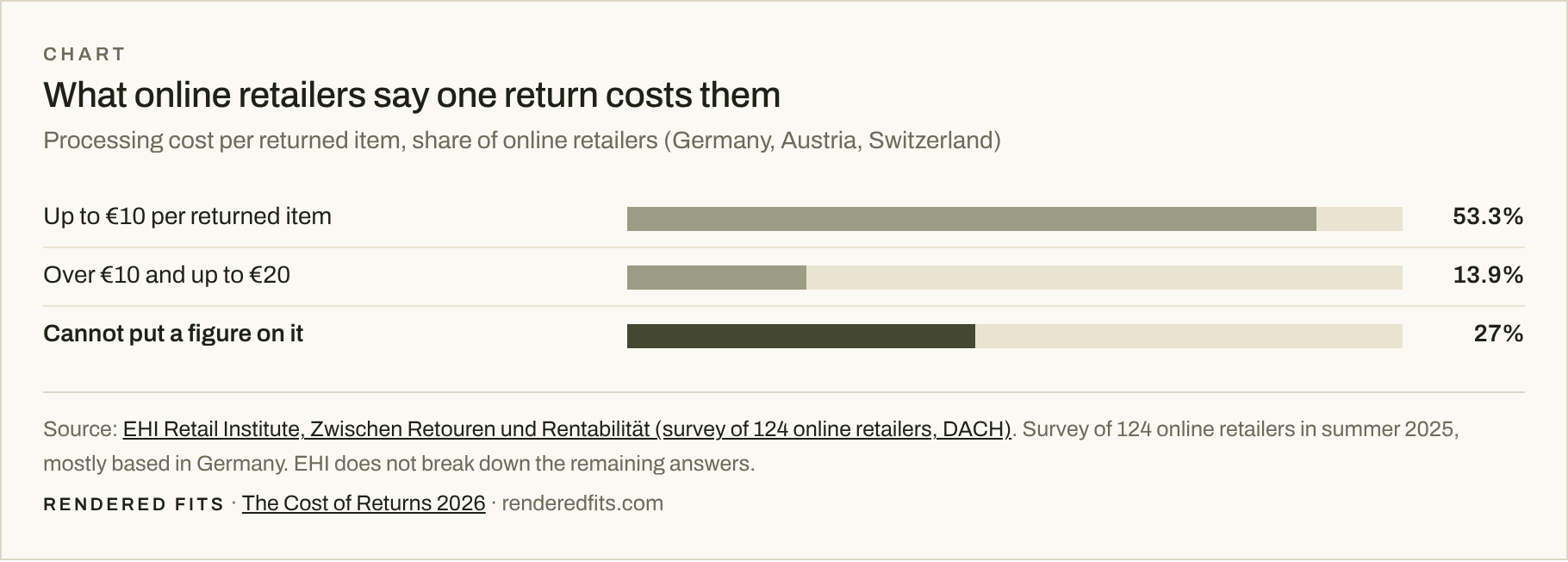
A newer survey asked retailers directly. In the EHI Retail Institute's 2025 survey of 124 online retailers in Germany, Austria and Switzerland, just over half put their processing cost at up to €10 per returned item, and 27% could not put a figure on it at all.
Chart
What online retailers say one return costs them
Processing cost per returned item, share of online retailers (Germany, Austria, Switzerland)
Source: EHI Retail Institute, Zwischen Retouren und Rentabilität (survey of 124 online retailers, DACH). Survey of 124 online retailers in summer 2025, mostly based in Germany. EHI does not break down the remaining answers.
Rendered Fits · Chart from The Cost of Returns 2026, reviewed 10 November 2026
Embed, download or cite this chart
You may embed this chart or use the image with a link to this page. Please cite the original publisher for each figure. The figures belong to their publishers, who may not allow reuse or redistribution. Rendered Fits does not grant a Creative Commons or other open licence over those figures.
Not knowing the cost is the bigger problem: a retailer that cannot price a return cannot tell whether a free-returns policy, a return fee or a better size guide pays for itself. The calculator below turns your own return rate and cost per return into a yearly figure.
What do returns cost retailers in total?
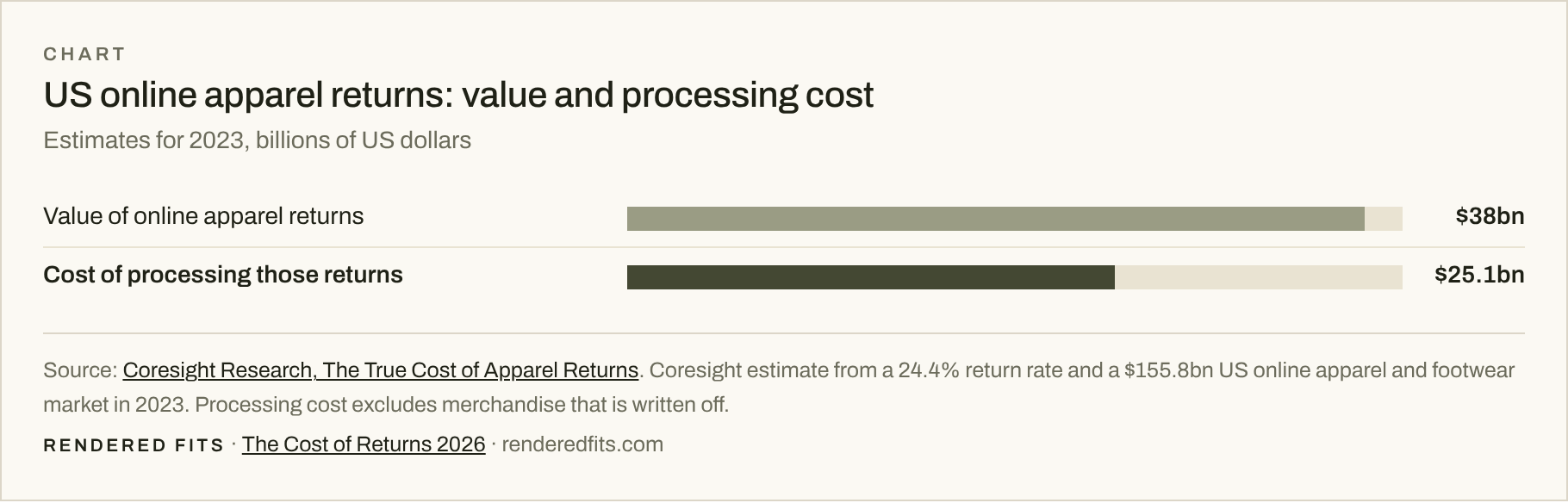
Coresight Research estimates that US online apparel returns were worth $38 billion in 2023 and cost $25.1 billion to process. Across all US retail, the National Retail Federation (NRF) expects $849.9 billion of merchandise to be returned in 2025.
Chart
US online apparel returns: value and processing cost
Estimates for 2023, billions of US dollars
Source: Coresight Research, The True Cost of Apparel Returns. Coresight estimate from a 24.4% return rate and a $155.8bn US online apparel and footwear market in 2023. Processing cost excludes merchandise that is written off.
Rendered Fits · Chart from The Cost of Returns 2026, reviewed 10 November 2026
Embed, download or cite this chart
You may embed this chart or use the image with a link to this page. Please cite the original publisher for each figure. The figures belong to their publishers, who may not allow reuse or redistribution. Rendered Fits does not grant a Creative Commons or other open licence over those figures.
Coresight surveyed 100 decision-makers at US apparel brands and retailers with at least $10 million in revenue in March 2023. Online-based companies with more than $100 million in online apparel revenue told Coresight that eliminating returns would lift their online apparel profit by over 50%. Two in three respondents (67%) said it would lift it by at least 20%, and 98% said they offer free shipping on returns.
Chart
Value of US retail returns, 2022 to 2025
Merchandise returned, all categories and channels, US$ billion
- $816bn2022
- NRF changed its method in 2023$743bn2023
- $890bn2024estimate
- $849.9bn2025estimate
Source: NRF and Appriss Retail, 2022 Consumer Returns in the Retail Industry; NRF and Appriss Retail, 2023 Consumer Returns in the Retail Industry; NRF and Happy Returns, 2024 retail returns report; NRF and Happy Returns, 2025 Retail Returns Landscape. NRF says 2023 figures cannot be compared with 2022 because its method changed.
Rendered Fits · Chart from Fashion Return Statistics 2026, reviewed 9 November 2026
Embed, download or cite this chart
You may embed this chart or use the image with a link to this page. Please cite the original publisher for each figure. The figures belong to their publishers, who may not allow reuse or redistribution. Rendered Fits does not grant a Creative Commons or other open licence over those figures.
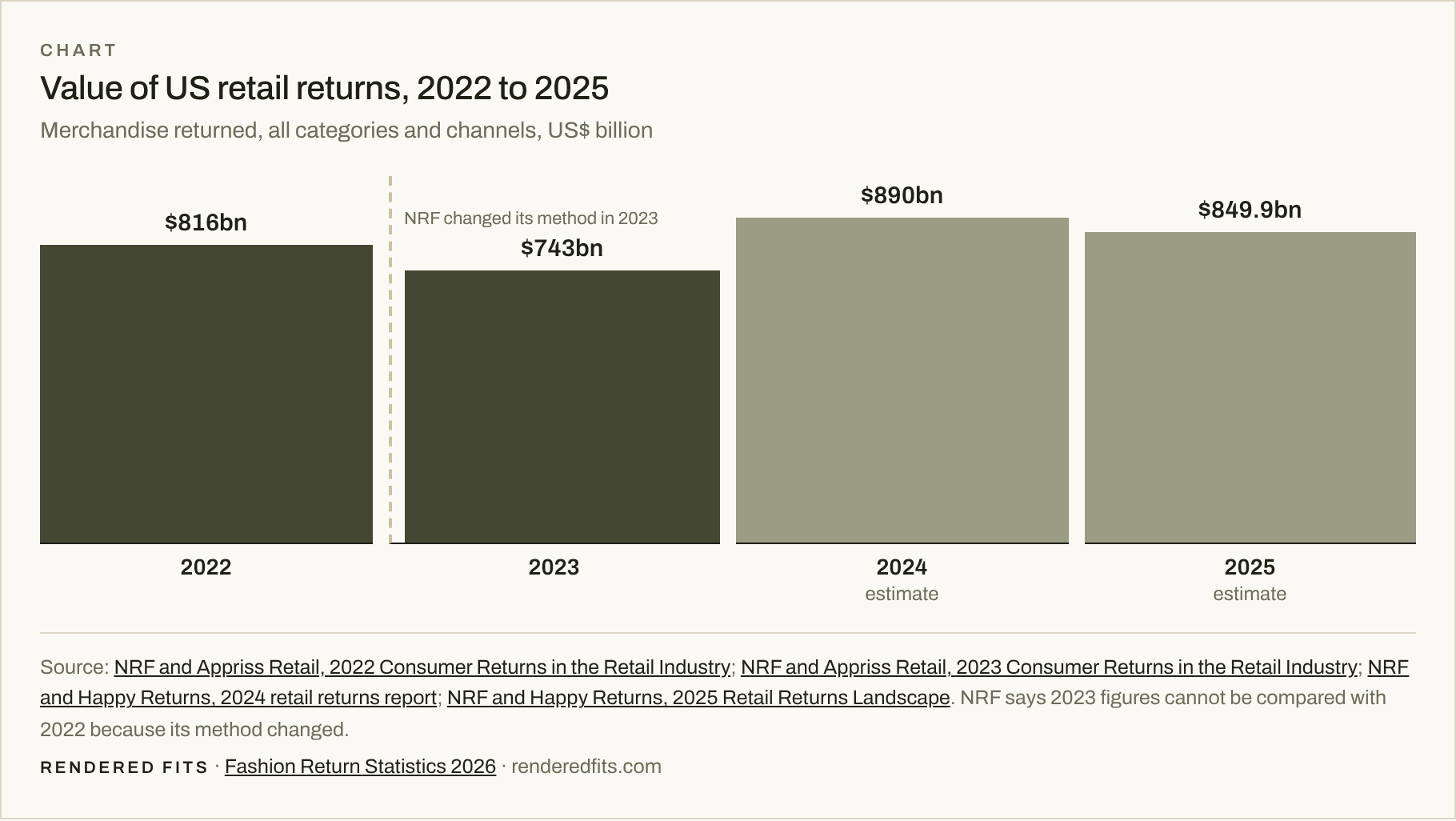
The NRF figures measure the value of goods returned, not the cost of handling them. The NRF and Appriss Retail found that in 2023, retailers lost $13.70 to return fraud for every $100 of returned merchandise accepted, about $101 billion in total. In 2025, retailers told the NRF that 9% of returns were fraudulent.
In the UK, Retail Economics and ZigZag put the value of non-food returns at £26.7 billion in 2024 and forecast £25.1 billion for 2025, with the return rate easing from 21% to 19.5%.
How many parcels are returned?
Almost one in four ecommerce parcels in Germany is sent back (24.2%). The University of Bamberg estimates 542 million return parcels in 2025 and forecasts 560 million in 2026, the highest on record.
Chart
Return parcels in German ecommerce, 2021 to 2026
Millions of B2C ecommerce parcels sent back to retailers in Germany
- 530m2021about
- n/a2022not estimated
- n/a2023not estimated
- 530m2024about
- 542m2025estimate
- 560m2026forecast
Source: University of Bamberg, Forschungsgruppe Retourenmanagement, European Return-o-Meter (Asdecker, Felch and Karl); University of Bamberg, Forschungsgruppe Retourenmanagement, 2025 return parcel estimate; University of Bamberg, Forschungsgruppe Retourenmanagement, updated 2026 return parcel estimate. Bamberg applies the 24.2% parcel return rate from its 2022 retailer survey to each year's parcel volumes, so the trend follows parcel volumes, not a newly measured return rate. Bamberg published no estimate for 2022 or 2023.
Rendered Fits · Chart from The Cost of Returns 2026, reviewed 10 November 2026
Embed, download or cite this chart
You may embed this chart or use the image with a link to this page. Please cite the original publisher for each figure. The figures belong to their publishers, who may not allow reuse or redistribution. Rendered Fits does not grant a Creative Commons or other open licence over those figures.
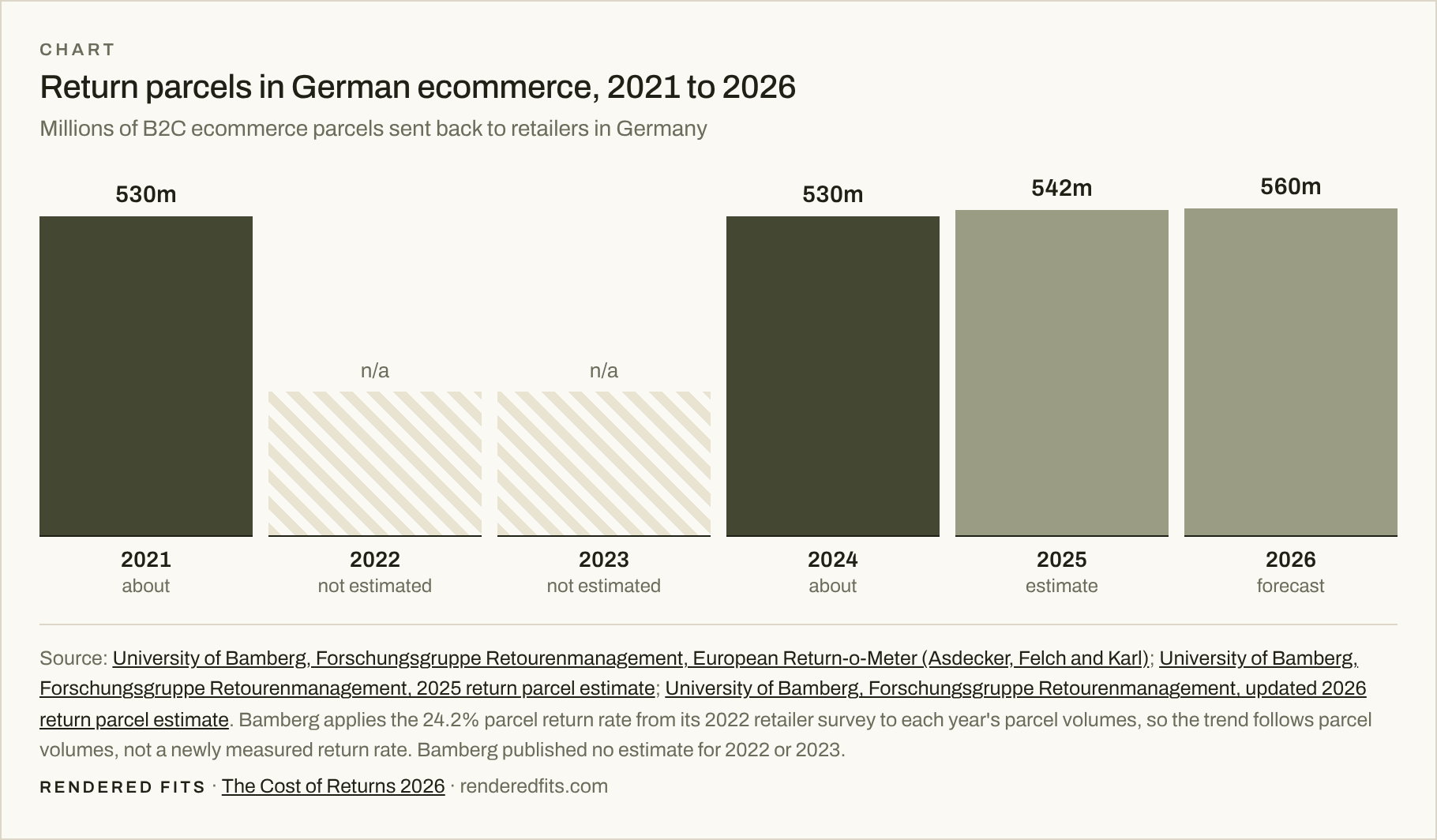
Bamberg multiplies its measured return rate by industry parcel volumes. For 2026 it uses 4.48 billion courier, express and parcel shipments, of which 87.3% are parcels and 73% are business-to-consumer. That gives about 2.3 billion parcels sent and 560 million sent back. Retailers in Bamberg's network report no fall in return rates, and their reports even hint at a slight rise, which Bamberg links to more shopping in apps that show less product information than desktop sites.
Fashion dominates the flow: 83% of return parcels and 91% of returned items in Germany are fashion. In the EHI survey, 12.2% of clothing retailers get more than half of all orders sent back.
Are returned clothes thrown away?
Rarely by the retailer directly: in Germany 93.2% of returned items are sold again as new and 1.3% are disposed of. Because volumes are so large, that 1.3% was still about 17 million items in 2021.
Chart
What happens to items returned to online retailers in Germany
Share of returned items, weighted average across surveyed retailers
Source: University of Bamberg, Forschungsgruppe Retourenmanagement, European Return-o-Meter (Asdecker, Felch and Karl). From a 2022 survey of 411 retailers. The remaining items are not broken down in the published summary. Disposal by resellers, and goods refunded without being sent back, are not counted.
Rendered Fits · Chart from The Cost of Returns 2026, reviewed 10 November 2026
Embed, download or cite this chart
You may embed this chart or use the image with a link to this page. Please cite the original publisher for each figure. The figures belong to their publishers, who may not allow reuse or redistribution. Rendered Fits does not grant a Creative Commons or other open licence over those figures.
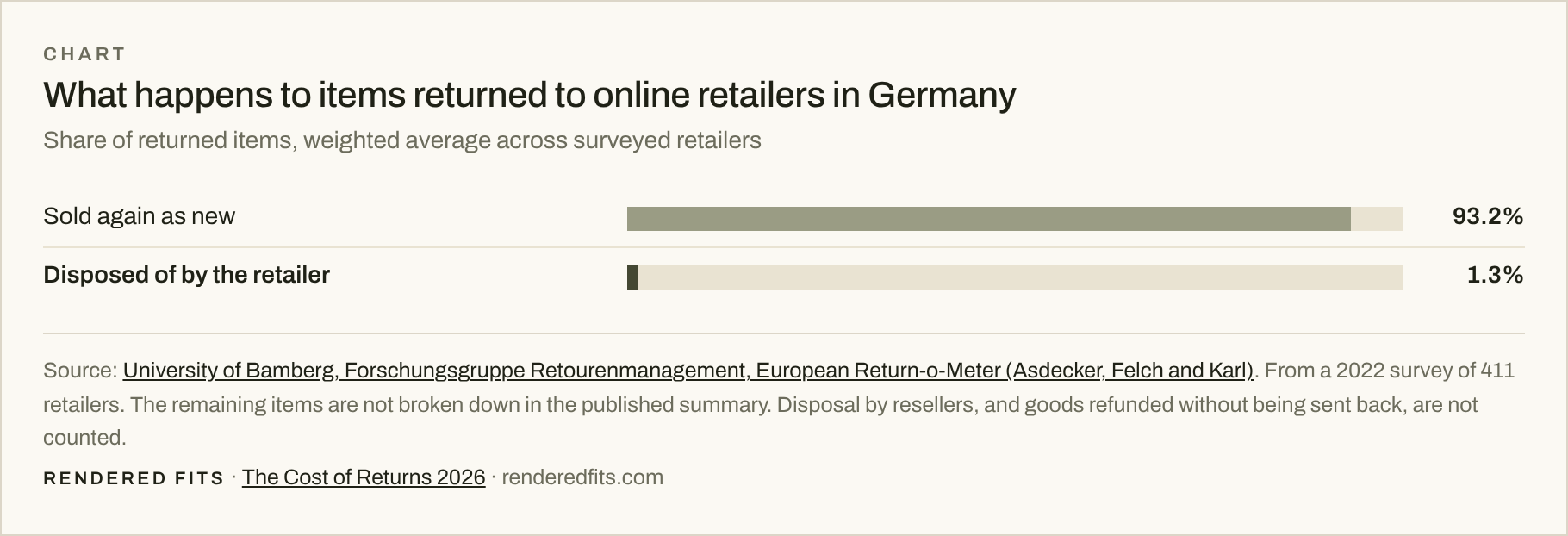
The 1.3% covers only disposal by the online retailer. Items passed to resellers and later destroyed, and goods refunded without being sent back, are not counted, so Bamberg notes the figure shows only part of the problem. It also found that, in Germany and the rest of Europe alike, disposing of returns is apparently more attractive to retailers than donating them. Bamberg published a further report on why returns and overstock are destroyed in July 2026.
What is the carbon footprint of a return?
About 1,500 g CO2e per return parcel, on average, among German retailers that measure it. On that figure, returns in Germany caused about 795,000 tonnes of CO2e in 2021, as much as driving a car 5.3 billion kilometres.
Chart
Carbon footprint of one return parcel
Grams of CO2 equivalent (CO2e) per returned parcel, Germany
Source: University of Bamberg, Forschungsgruppe Retourenmanagement, European Return-o-Meter (Asdecker, Felch and Karl). Fewer than 5% of surveyed retailers measure the footprint, so the mean rests on a small group. Bamberg calls for independent research on the figure.
Rendered Fits · Chart from The Cost of Returns 2026, reviewed 10 November 2026
Embed, download or cite this chart
You may embed this chart or use the image with a link to this page. Please cite the original publisher for each figure. The figures belong to their publishers, who may not allow reuse or redistribution. Rendered Fits does not grant a Creative Commons or other open licence over those figures.
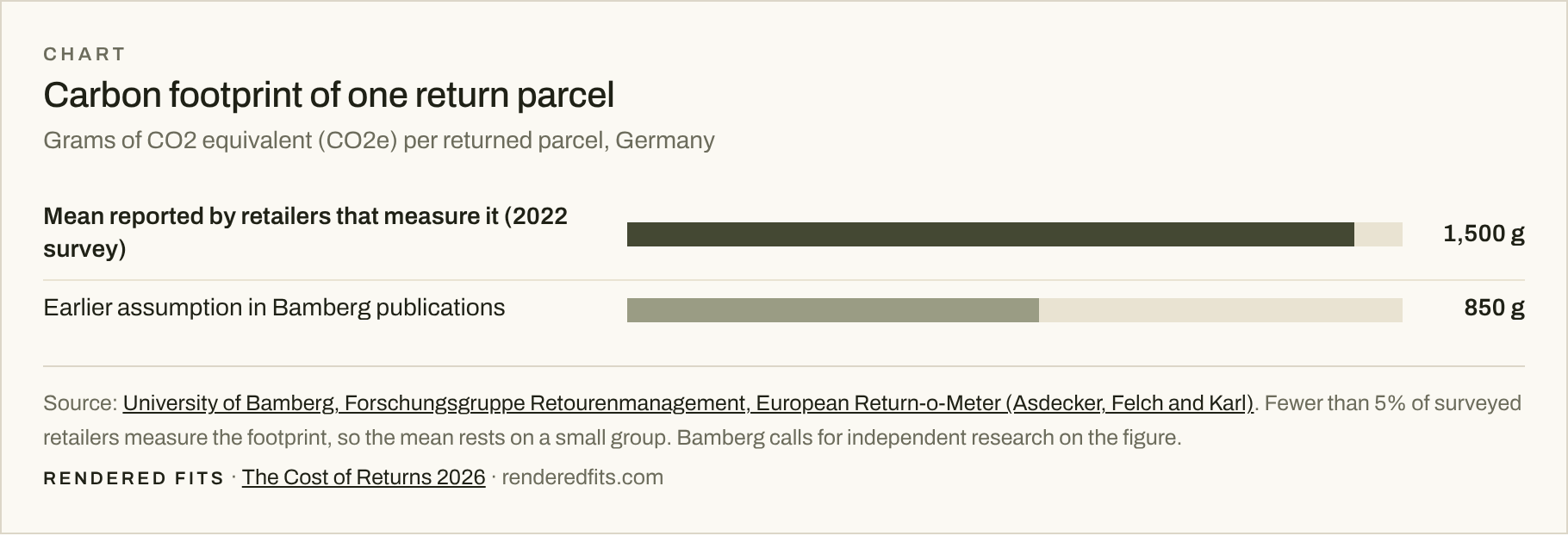
Treat this number with care. More than 80% of retailers in the Bamberg survey do not measure the footprint of a return, 15% did not know or did not answer, and fewer than 5% do measure it. The 1,500 g mean comes from that small group, and Bamberg says independent research is urgently needed. Even so, it is well above the 850 g Bamberg had assumed before, so the climate cost of returns has probably been underestimated.
Why does Germany have so many returns?
Bamberg found the highest return rates in Europe in Germany, with Switzerland and Austria close behind, and points to three causes: more free returns, more orders paid by invoice after delivery, and longer return windows.
Chart
Return policies in Germany and the rest of Europe
Online retailers in the same 2022 survey, Germany vs the rest of Europe
- Retailers offering free returnsGermany: 88.7%Rest of Europe: 52.4%
- Orders paid by invoiceGermany: 28.8%Rest of Europe: 9.9%
Source: University of Bamberg, Forschungsgruppe Retourenmanagement, European Return-o-Meter (Asdecker, Felch and Karl). Both groups come from the same survey and method. The average return window was 53.5 days in Germany and 29.6 days in the rest of Europe.
Rendered Fits · Chart from The Cost of Returns 2026, reviewed 10 November 2026
Embed, download or cite this chart
You may embed this chart or use the image with a link to this page. Please cite the original publisher for each figure. The figures belong to their publishers, who may not allow reuse or redistribution. Rendered Fits does not grant a Creative Commons or other open licence over those figures.
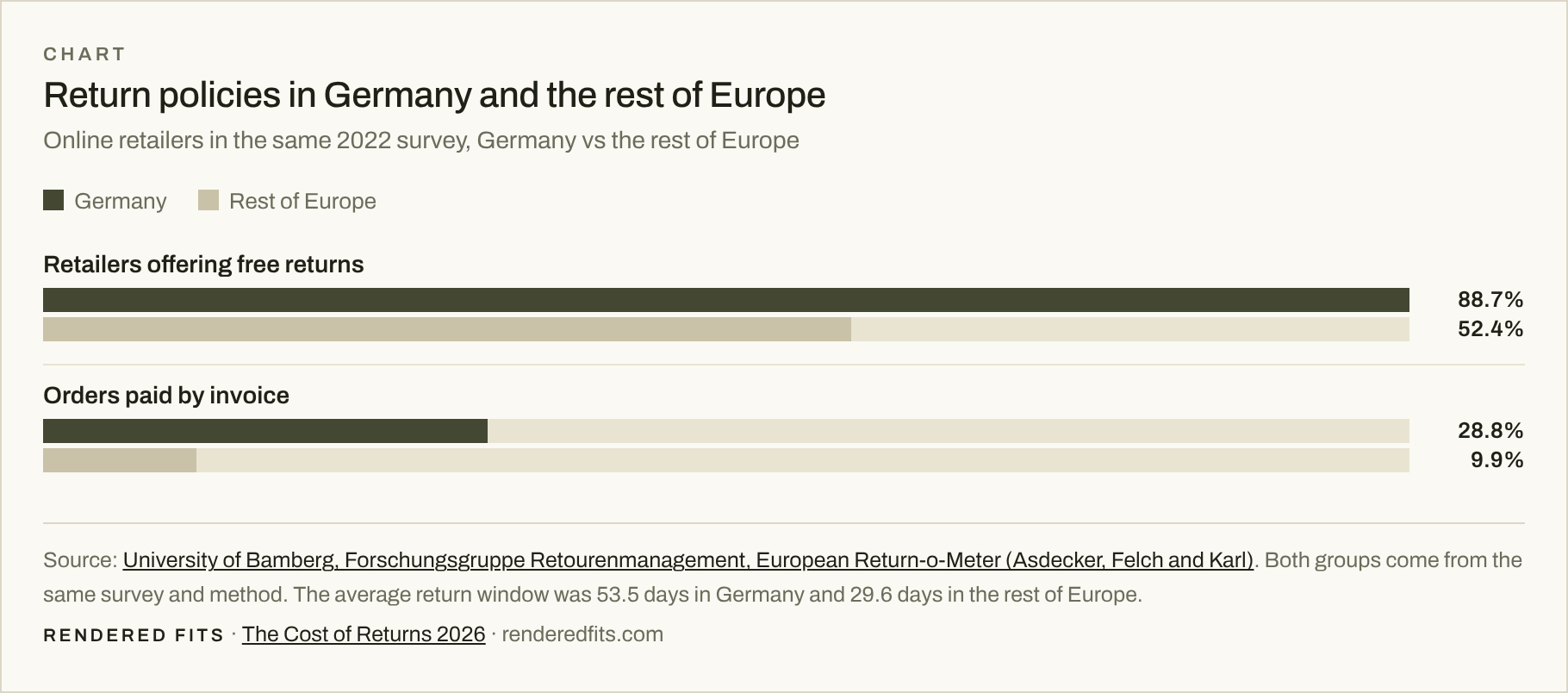
In the same survey, the average return window was 53.5 days in Germany against 29.6 days in the rest of Europe. Outside Germany, almost half of retailers make shoppers pay part of the cost: 17.9% charge a return fee and 29.7% leave the postage to the customer. German retailers do achieve lower costs per return than their European competitors.
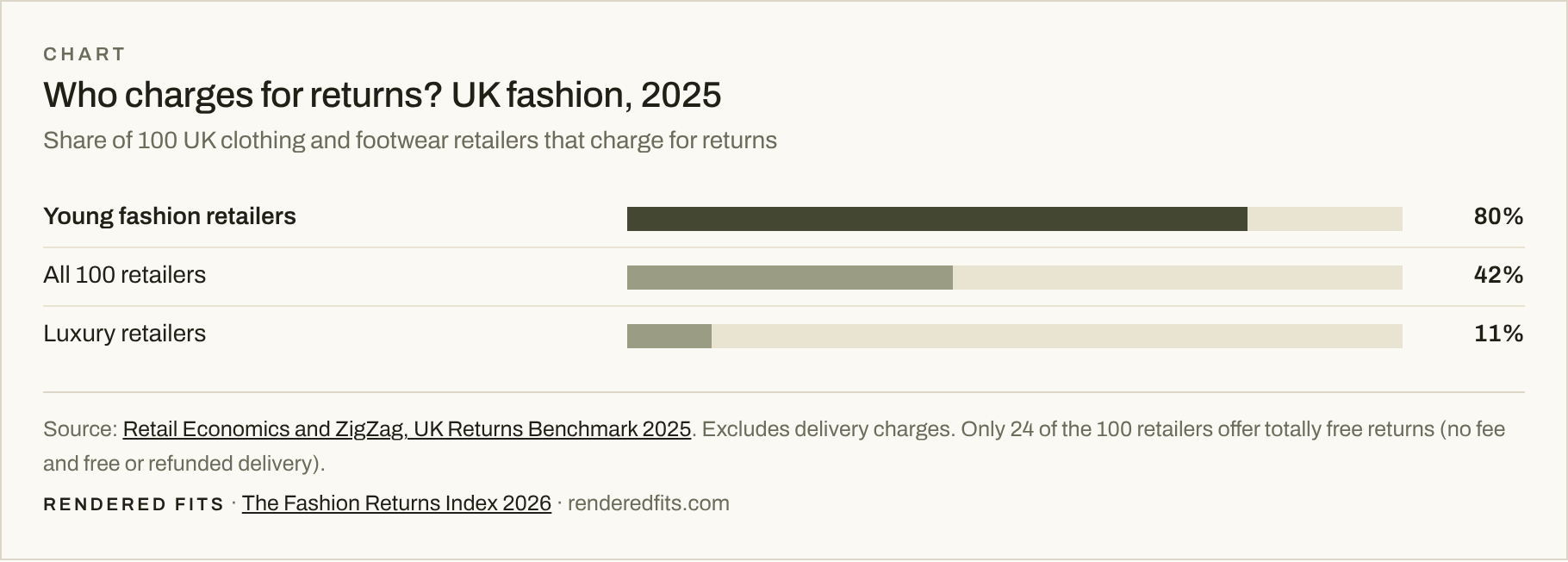
In the UK, Retail Economics and ZigZag found that 42% of clothing and footwear retailers charge for returns.
Chart
Who charges for returns? UK fashion, 2025
Share of 100 UK clothing and footwear retailers that charge for returns
Source: Retail Economics and ZigZag, UK Returns Benchmark 2025. Excludes delivery charges. Only 24 of the 100 retailers offer totally free returns (no fee and free or refunded delivery).
Rendered Fits · Chart from The Fashion Returns Index 2026, reviewed 9 November 2026
Embed, download or cite this chart
You may embed this chart or use the image with a link to this page. Please cite the original publisher for each figure. The figures belong to their publishers, who may not allow reuse or redistribution. Rendered Fits does not grant a Creative Commons or other open licence over those figures.
Returns cost calculator
Multiply your orders by your return rate and your all-in cost per return to see what returns cost you each year, and what one percentage point of return rate is worth.
Estimate your yearly cost of returns
Enter your own figures, in any currency. Nothing is sent anywhere.
The defaults are illustrations only: Coresight's 24.4% return rate for US online apparel orders and Bamberg's €6.95 average transport and processing cost per return parcel in Germany. Include return postage, warehouse handling, customer service and any write-downs in your cost per return.
Returns also cost sales you never see: in the UK, Retail Economics found that 49% of shoppers, and six in ten Millennials, have abandoned a purchase because of an unsatisfactory returns policy. Charging for returns can lower the bill and lose orders at the same time.
How can fashion brands cut the cost of returns?
By preventing the returns that come from size and fit, the reason apparel companies name most often, rather than only charging for returns or processing them faster.
- Prevent size-related returns. In Coresight's survey, 53% of US apparel decision-makers named size or fit the top reason for returns. Zalando says its size and fit tools prevented 9% of size-related returns in 2026. See the Fashion Returns Index for every published figure.
- Price your returns. Know your all-in cost per return before you change your policy, so a return fee or a shorter window can be judged against the sales it may lose.
- Record the reasons. Only 29.5% of retailers in the EHI survey capture return reasons fully automatically, and 7.3% use AI in returns management. Reasons tied to products show which size charts and descriptions cause returns.
- Resell quickly. Most retailers in the EHI survey (43.4%) need one to two days to process a return. Faster processing gets items back on sale at full price sooner.
For figures on whether try-on and size tools lower returns, see the virtual try-on returns benchmark.
How this page is compiled
We list a figure only if its publisher names the data behind it, and we link to that publication. Widely repeated figures whose original source we could not find or read are left out, including undated vendor estimates of returns sent to landfill. The German return-parcel series is Bamberg's own estimate; we have not modelled or adjusted any figure. Each figure is re-read every quarter and changes are logged here. Corrections: data@renderedfits.com.
Change log
- 10 November 2026: first edition, with Bamberg's 2026 return parcel forecast, the EHI 2025 retailer survey and the European Return-o-Meter.
How to cite this page
Please cite the original publication for each figure, and this page as the place you found it. Rendered Fits does not grant a Creative Commons or other open licence over the figures, because those rights sit with the original publishers. Last reviewed 10 November 2026; we review the page every quarter.
- APA
Stones, S. (2026, November 10). The Cost of Returns 2026. Rendered Fits. https://www.renderedfits.com/cost-of-returns-2026/- Harvard
Stones, S. (2026) The Cost of Returns 2026. Rendered Fits. Available at: https://www.renderedfits.com/cost-of-returns-2026/ (Accessed: 10 November 2026).- Link (HTML)
<a href="https://www.renderedfits.com/cost-of-returns-2026/">The Cost of Returns 2026</a> (Rendered Fits)
Sources
- Asdecker, B., Felch, V. and Karl, D., European Return-o-Meter, Forschungsgruppe Retourenmanagement, University of Bamberg (7 September 2022)
- University of Bamberg, Forschungsgruppe Retourenmanagement, updated estimate of return parcels in 2026 (30 September 2026)
- University of Bamberg, Forschungsgruppe Retourenmanagement, record of 550 million return parcels expected in 2025 (25 November 2025)
- EHI Retail Institute, Zwischen Retouren und Rentabilität, survey of 124 online retailers (27 November 2025)
- Coresight Research, The True Cost of Apparel Returns (survey of 6 March 2023)
- NRF and Happy Returns, 2025 Retail Returns Landscape (15 October 2025)
- NRF and Happy Returns, 2024 retail returns report (5 December 2024)
- NRF and Appriss Retail, 2023 Consumer Returns in the Retail Industry (26 December 2023)
- NRF and Appriss Retail, 2022 Consumer Returns in the Retail Industry (13 December 2022)
- Retail Economics and ZigZag, UK Returns Benchmark 2025
- Zalando, Returns at Zalando (read 9 November 2026)
Every figure on this page links to the publication it comes from. Rendered Fits does not publish a cost figure of its own. Last reviewed 10 November 2026 by Sienna Stones.
Frequently asked questions
How much does it cost to process a return?
In Germany, transport and processing cost online retailers €2.85 per returned item and €6.95 per return parcel on average (University of Bamberg, 2021 data). In a 2025 EHI survey, 53.3% of online retailers in Germany, Austria and Switzerland put the cost at up to €10 per item, and 27% could not put a figure on it.
How much do returns cost retailers in total?
Coresight Research estimates that processing US online apparel returns cost $25.1 billion in 2023, on returns worth $38 billion. Across all US retail, the NRF expects $849.9 billion of goods to be returned in 2025. UK non-food returns were worth £26.7 billion in 2024.
How many parcels are returned in Germany?
The University of Bamberg estimates 542 million return parcels in 2025 and forecasts 560 million in 2026, a record. Almost one in four ecommerce parcels (24.2%) is sent back, and fashion accounts for 83% of return parcels.
Are returned clothes thrown away?
Rarely by the retailer itself. In Germany, 93.2% of returned items are sold again as new and 1.3% are disposed of by the retailer, which was still about 17 million items in 2021. Disposal by resellers is not included in that figure.
What is the carbon footprint of a return?
German retailers that measure it report about 1,500 g CO2e per return parcel on average, according to the University of Bamberg. Fewer than 5% of retailers measure it, so the figure rests on a small group.
Why does Germany have so many returns?
The University of Bamberg points to free returns (88.7% of German retailers vs 52.4% in the rest of Europe), orders paid by invoice after delivery (28.8% vs 9.9%) and longer return windows (53.5 days vs 29.6 days).
How can fashion brands reduce the cost of returns?
Prevent the returns that come from size and fit, the reason apparel companies name most often; know your all-in cost per return before changing your returns policy; and record return reasons by product so the size charts and descriptions that cause returns can be fixed.
About Rendered Fits. Rendered Fits is a Shopify app for fashion brands that recommends a size for supported products from the brand's own size chart, and can show shoppers an optional AI try-on preview. There is a Free plan (one product, 5 try-ons a month, with a PREVIEW watermark). Complete is $349 a month plus any applicable taxes, with a 14-day trial of 50 try-ons in total, then 1,000 try-ons per paid cycle. Extra try-ons cost $0.50 each, but only if you turn them on and set a spending cap. Enterprise is $999 a month plus any applicable taxes, with 5,000 try-ons per paid cycle, then $0.35 each extra on the same terms, and no trial.
Related: Fashion Returns Index 2026 · UK online clothing sales statistics 2026 · Fashion return statistics 2026 · Virtual try-on returns benchmark · What is bracketing? · Shopify app to reduce returns